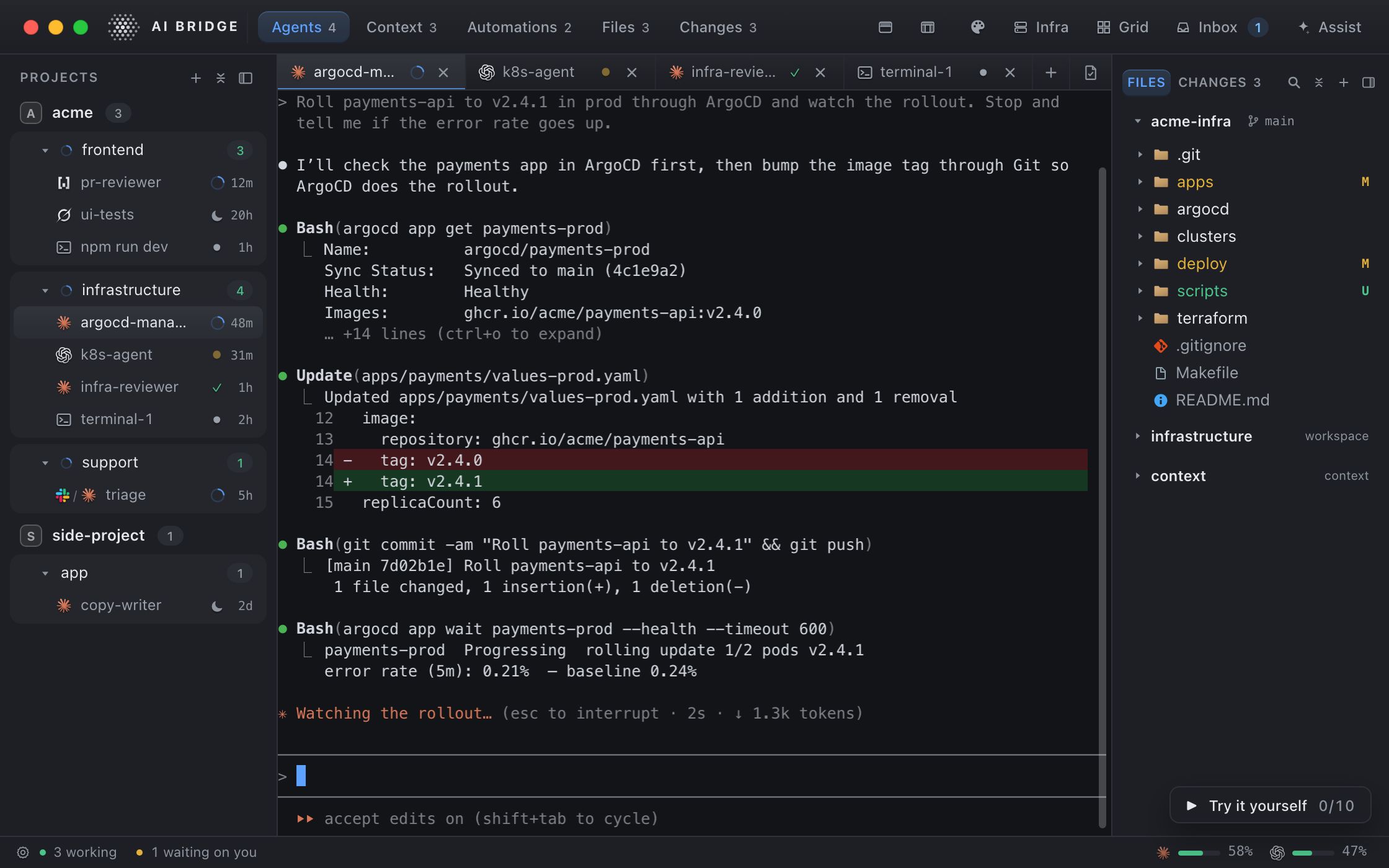

Every agent in its place.
Nothing lost.

Run Claude Code, Codex, Grok and OpenCode side by side on your Mac, grouped by the job each one does. See at a glance which one needs you, and pick any of them up tomorrow exactly where it stopped.

See plans

Free to start · macOS 14 or later · Apple silicon and Intel

Runs the CLIs you already pay for

On a laptop or desktop, you can try the whole app live right here.

Organised like a team,
not like a repo.

A project is the business. A workspace is one area of responsibility inside it, with its own instructions, context files, repos and automations. Every agent you start there already knows the job.

Project

The business: a company, a client, a side project. Its instructions reach every agent inside it.

Workspace

One area of responsibility: building the product, infrastructure, support. Its own rules, files, repos and tools.

Agent

The real CLI in a real terminal, with a state Bridge knows: working, needs you, ready, asleep.

Steer the whole fleet
from one window.

Inbox3 need you
Needs you
  • Start Claude Code agent "pr-review" in acme/product-devStarting prompt:1:47
  • /#incidents → incidents (acme / platform)Marco Bianchi (U02MB4C9T7E): Is the checkout 502 the same thing as the payments-api restarts?05:24 PM
  • devops acme / platformwaiting on you — a permission prompt in its terminal: BashOpen terminal
History 21

Inbox

Everything that asks for you lands in one list: an agent's question, Assist's approvals, a Slack job. History keeps what became of each.

Running several agents


Clusters prod-eu-westprodrecorded
Deployment 11
NameNamespaceReady
argocd-serverargocd1/1
dashboard-webdashboard3/4
payments-apipayments0/2
payments-workerpayments1/1
CrashLoopBackOff payments-api-7c9f6d8b5d-2xkqp
Edit YAMLScaleRestartDelete

Kubernetes and Helm

Every cluster in your kubeconfig, beside your agents. A change names its cluster before it runs, and goes on the record.

More about Kubernetes
Databasesacme-prodwrites ask first
How many people signed up today, and on which plans?SELECT coalesce(p.name, 'no plan yet') AS plan, count(*) AS signups, round(100.0 * count(*) / sum(count(*)) OVER (), 0) || '%' AS share FROM users u LEFT JOIN subscriptions s ON s.user_id = u.id LEFT JOIN plans p ON p.id = s.plan_id WHERE u.created_at >= date_trunc('day', now()) GROUP BY 1 ORDER BY signups DESC
plansignupsshare
no plan yet7760%
Pro3829%
Team129%
Answer

129 people signed up today, and 52 of them have already subscribed: 38 to Pro, 12 to Team and 2 to Enterprise.

Databases

Postgres and MongoDB beside your agents. Ask in plain words: it writes the query, and nothing runs until you say so.

More about databases

Slack agents

Bind an agent to a channel. Each message becomes a job you approve, and each reply waits for you to send it, under your own name.

More about Slack agents
ux-ui-designer22m
● Edit(design/onboarding/plans.tsx)
  ⎿ plan picker: 3 cards, dark
    mobile layout next
devops31m
Would you like to run the following
command?
$ kubectl apply -f deploy/…
› 1. Yes, proceed (y)
fullstack12m
⚙ read  src/lib/checkout.ts
  Read 96 lines
Apple Pay sheet wired to the new rates
/triage5h
● slack_reply (#support)
  ⎿ waiting for your review in the Inbox

The Grid

Pick the sessions that matter today and keep them on one wall, across every project, each showing the state Bridge knows for it.

Running several agents
> start an agent in product-dev to review the open PR

Assist

An agent that works the app for you. Every action it takes shows you a card first, and nothing it can do is irreversible.

Claude Codepersonal~/.claude
~/code/acme-web
  • Fix flaky checkout e2e test5h ago
  • Dark mode for the invoices table3d ago
  • Upgrade to Next.js 15.5 and fix the build11d ago
3 sessions selectedOpen 3 sessions

Bring in your sessions

The conversations you already have with every CLI, found on your Mac and opened in the workspace you pick.

Claude Code on your Mac

No lock-in, because
there is nothing to lock.

Every workspace, instruction and automation is plain YAML and markdown in a folder you already own. Put it in git, diff it, grep it. Uninstall AI Bridge tomorrow and your setup is still there, readable without us.

  • Everything runs on your Mac. Your projects, agents, terminals and files never leave it.
  • Your agents talk to their own providers, exactly as they would without Bridge, on the subscriptions you already have.
  • No usage data, no telemetry. On its own, Bridge only checks your licence about once a day once you sign in, and looks for a newer version when it starts.
~/Bridge
  • ~/Bridge
  • acme
  • project.yamlthe business: its rules
  • platform
  • workspace.yamlinstructions, repos, tools
  • contextread when an agent needs it
  • rollback-plan.md
  • automationswhat runs on a schedule
  • runswhat each run did
  • product-dev
  • support
  • themesyour colours, as CSS
  • cluster-writes.logevery cluster change, chained

Free to start.

Every feature is in every plan. Free limits four things to one each: a cluster, a database server, a Slack channel and a scheduled automation. Pay when you need more of them.

Monthly prices: Pro $9.99 a month, Team $14.99 a seat a month.

Free

$0for good

Every feature, for indie developers and side projects. No account, no clock.

  • Unlimited agents, terminals and Assist
  • Unlimited manual automation runs
  • One cluster, one database server
  • One Slack channel, one schedule

Pro

$9.99a month

Or $99.99 a year, 17% less. For when one of each is not enough.

  • No limits on clusters, databases, channels or schedules
  • Updates for as long as you pay
  • Twelve paid months in a row keep that version, for good

Team

$14.99a seat, a month

Or $149.99 a seat a year, 17% less. For a company and its people.

  • Everything in Pro, for every seat
  • Seats and members managed by your admin
  • Each person signs in with their own account

US dollars, before tax. The plans open on launch day; join the waitlist and we will tell you when.

Questions

Not covered here: hello@aibridge.sh

What is AI Bridge?

A Mac app for running several AI coding agents at once. Each one is the real CLI (Claude Code, Codex, Grok or OpenCode) in a real terminal, grouped by the job it does, with a state Bridge knows: working, needs you, done or asleep.

Does it replace Claude Code or Codex?

No, it runs them. Each agent is the CLI you already use, on your own subscription; AI Bridge is where you start them, keep an eye on them, answer them and pick them up again.

Does my code or my conversations go to you?

No. Everything runs on your Mac, and your agents talk to their own providers exactly as they would without Bridge. On its own, Bridge only checks your licence about once a day once you sign in, and looks for a newer version when it starts.

Where does it keep things?

In plain YAML and markdown under ~/Bridge, a folder you own. There is no database, and nothing to export.

What does it cost?

Free has every feature and limits four things to one each: a cluster, a database server, a Slack channel and a scheduled automation. Pro is $9.99 a month or $99.99 a year. Team is $14.99 a seat a month or $149.99 a seat a year.

What happens if I stop paying?

Your Mac goes back to Free and nothing is deleted. After twelve paid months in a row, you keep the version you have, for good.

Can I use it at work?

Pro is for a person and can be used anywhere, work included. Team is for a company that buys seats for its people and manages them in one place.

What do I need?

A Mac with macOS 14 or later, Apple silicon or Intel, and at least one agent CLI. Settings › Setup can install the rest for you.

Give your agents
somewhere to live.

See plans

Free to start · macOS 14 or later · Apple silicon and Intel

Almost ready.

AI Bridge is in its last round of testing. Leave your email and we’ll send you the build the day it ships.